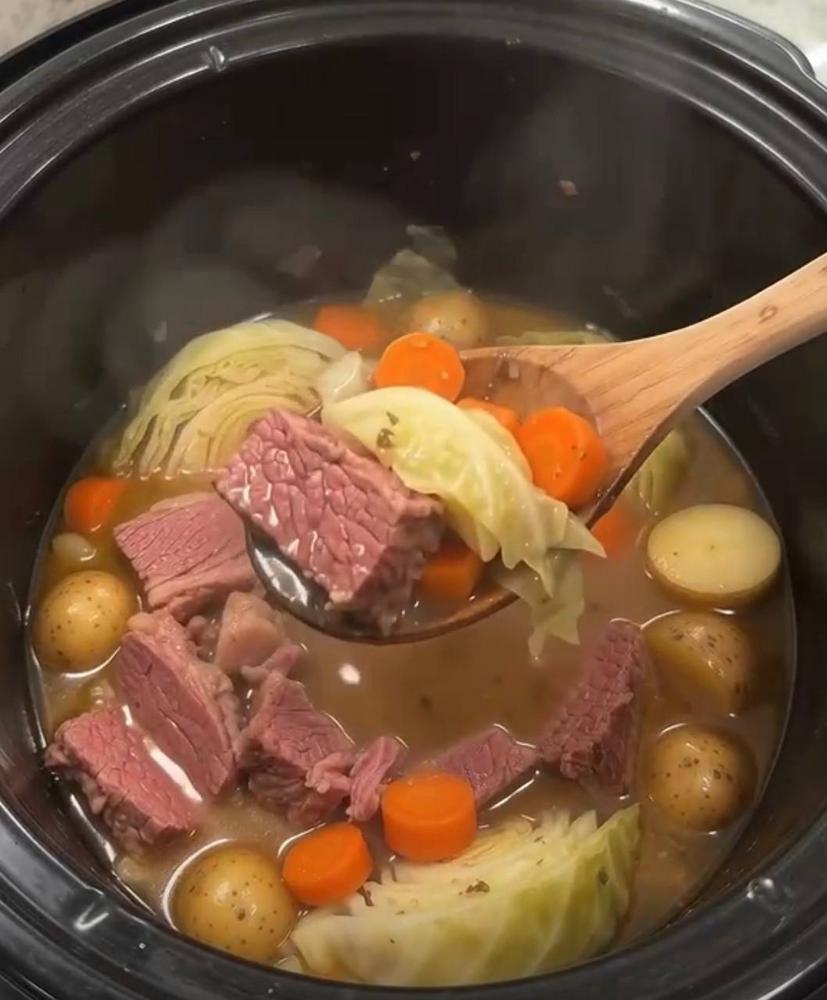
Instructions
- Prepare the Corned Beef: Remove the corned beef brisket from its packaging. Rinse it thoroughly under cold water to remove any excess brine. This step is crucial for reducing the overall saltiness of the dish.
- Layer the Aromatics: Place the quartered onion at the bottom of your large slow cooker (6-quart or larger is recommended). This creates a bed for the meat and infuses the broth with flavor from the start.
- Add the Corned Beef and Spices: Place the rinsed corned beef brisket on top of the onions. If your corned beef came with a spice packet, sprinkle its contents evenly over the meat. If not, add the bay leaves, black peppercorns, and dried thyme directly over the corned beef.
- Add Liquids: Pour the beef broth (or water) and the optional Guinness beer or hard cider around the corned beef. The liquid should cover at least two-thirds of the meat. If it doesn’t, add a little more broth or water until it does.
- Slow Cook the Beef: Cover the slow cooker with its lid. Cook on LOW for 6-8 hours or on HIGH for 3-4 hours, until the corned beef is fork-tender. The exact time will depend on the size and thickness of your brisket. You should be able to easily pull it apart with a fork.
- Prepare Vegetables: About 2-3 hours before the end of the cooking time (if cooking on LOW) or 1-1.5 hours before (if cooking on HIGH), carefully remove the lid.
- Add Root Vegetables: Gently add the potatoes and carrots to the slow cooker, tucking them around the corned beef. Ensure they are mostly submerged in the liquid. If needed, add a little more broth to cover them.
- Continue Cooking with Vegetables: Replace the lid and continue cooking until the potatoes and carrots are tender when pierced with a fork, but not mushy.
- Add Cabbage: In the last 30-60 minutes of cooking (depending on how firm you like your cabbage), carefully add the cabbage wedges to the slow cooker. You may need to press them down slightly to submerge them in the liquid.
- Finish Cooking: Continue cooking until the cabbage is tender but still has a slight bite. Do not overcook the cabbage, or it will become mushy.
- Rest and Slice the Beef: Once everything is cooked, carefully remove the corned beef from the slow cooker and place it on a cutting board. Tent it loosely with foil and let it rest for 10-15 minutes. This allows the juices to redistribute, resulting in a more tender and flavorful slice.
- Serve: While the beef is resting, you can carefully remove the vegetables from the slow cooker and arrange them on a large platter. Skim any excess fat from the cooking liquid if desired.
- Slice Against the Grain: After resting, slice the corned beef against the grain into 1/4 to 1/2-inch thick slices. This is crucial for tenderness.
- Assemble and Garnish: Arrange the sliced corned beef, cabbage, potatoes, and carrots on individual plates or a large serving platter. Ladle some of the flavorful cooking broth over the meat and vegetables. Garnish with fresh chopped parsley, if using.
- Taste and Adjust: Taste the broth and vegetables. If necessary, season with a little more salt and freshly ground black pepper, remembering that the corned beef itself is quite salty.
Cooking Tips and Variations
For the most tender corned beef, always opt for the “flat cut” if you prefer leaner meat that slices beautifully, or the “point cut” for a richer flavor and a meat that’s ideal for shredding. Rinsing the corned beef thoroughly under cold water before cooking is a vital step to prevent the finished dish from being overly salty, as the curing process infuses it with a significant amount of salt. When adding liquids, consider using a dark beer like Guinness or a hard cider alongside the beef broth; these additions introduce a wonderful depth of flavor that complements the beef beautifully. If you don’t have these on hand, extra beef broth or even water will work just fine.
To ensure your vegetables are perfectly cooked and not mushy, timing is everything. Add the heartier root vegetables like potatoes and carrots about 2-3 hours into the cooking process on low, or 1-1.5 hours on high. The cabbage, being more delicate, should only be added during the last 30-60 minutes of cooking. This staggered approach ensures that everything reaches optimal tenderness simultaneously. For an extra boost of flavor, consider adding a few whole cloves of garlic to the slow cooker along with the onions at the beginning. If you’re feeling adventurous, a tablespoon of whole mustard seeds added with the spice packet can provide a delightful, subtle tang.
Don’t discard that flavorful cooking liquid! It’s a goldmine of taste. Skim off any excess fat from the top, and serve it alongside the meat and vegetables. It’s fantastic for dipping or drizzling over the entire meal. For a different twist, you could add other root vegetables such as parsnips or turnips along with the carrots and potatoes. If you enjoy a bit of heat, a pinch of red pepper flakes can be added to the cooking liquid. For those who prefer a slightly sweeter note, a tablespoon of brown sugar or maple syrup in the broth can balance the savory flavors nicely. Always remember to slice the corned beef against the grain after it has rested; this is the secret to achieving that melt-in-your-mouth tenderness.
Storage and Reheating
To store leftover corned beef and cabbage, allow the dish to cool completely to room temperature (no longer than 2 hours) before transferring it to airtight containers. You can store the meat and vegetables together or separately, depending on your preference. The flavorful cooking broth should also be stored in an airtight container. Refrigerated, the leftovers will keep well for 3-4 days. For longer storage, you can freeze the corned beef and vegetables (without the broth, as it can make vegetables mushy upon thawing) in freezer-safe bags or containers for up to 2-3 months. Thaw frozen leftovers overnight in the refrigerator before reheating.
When reheating, there are several effective methods. For individual servings, the microwave is quick and convenient. Place the corned beef, cabbage, and potatoes on a microwave-safe plate, add a splash of the reserved cooking broth, and heat on medium power in 1-minute intervals until thoroughly warmed through. For larger quantities or a more gentle reheat, you can use the stovetop. Place the leftovers in a pot or Dutch oven, add a bit of broth to prevent drying, cover, and heat over medium-low heat, stirring occasionally, until hot. Alternatively, you can reheat in the oven. Place the leftovers in an oven-safe dish with a little broth, cover with foil, and bake at 300°F (150°C) for 20-30 minutes, or until heated through. Be careful not to overcook the cabbage during reheating, as it can become overly soft. The broth can be reheated separately and served alongside the warmed components.
Frequently Asked Questions
What is the difference between flat cut and point cut corned beef?
The flat cut (or “first cut”) of corned beef brisket is leaner, has a more uniform shape, and is easier to slice neatly, making it ideal for presentation. The point cut (or “second cut”) is fattier, has more connective tissue, and is less uniform in shape. While it’s richer in flavor and more tender when slow-cooked, it tends to fall apart or shred rather than slice cleanly. Both cuts are delicious for corned beef and cabbage, so your choice depends on your preference for leanness and texture.
Can I make this recipe in an Instant Pot instead of a slow cooker?
Yes, you absolutely can! To adapt this recipe for an Instant Pot, you would typically cook the corned beef with the onions, spices, and liquids (broth, beer) on high pressure for about 90 minutes, followed by a natural pressure release for 15-20 minutes. Then, you would add the potatoes and carrots and pressure cook for another 5-7 minutes with a quick release. Finally, add the cabbage and cook for 2-3 minutes with a quick release. This significantly reduces the cooking time while still achieving tender results.
Why is my corned beef still tough after cooking for hours?
If your corned beef is still tough, it usually means it hasn’t cooked long enough. Corned beef brisket is a tough cut of meat that requires a long, slow cooking process to break down its connective tissues and become tender. Even if the recipe states a specific time, cooking times can vary based on the size and thickness of your brisket, as well as the actual temperature of your slow cooker. The best way to check for doneness is to use a fork; if it doesn’t easily shred or pull apart, it needs more time. Continue cooking until it reaches that desired fork-tender stage.